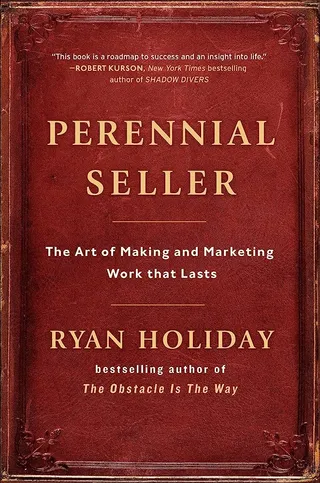
Perennial Seller
by Ryan Holiday
10 out of 10
Powerful insights about building long-lasting work.
8 highlights
"Chances are those companies will still exist in ten years. Whatever changes I will have to make to this book in later editions, I have little doubt that, barring some tragedy, the Pantry, Shawshank , Iron Maiden, and Zildjian will still be going strong. They are examples of a phenomenon known in economics as the Lindy effect. * Named after a famous restaurant where showbiz types used to meet to discuss trends in the industry, it observes that every day something lasts, the chances that it will continue to last increase. Or as the investor and writer Nassim Taleb has put it, “If a book has been in print for forty years, I can expect it to be in print for another forty years. But, and that is the main difference, if it survives another decade, then it will be expected to be in print another fifty years. . . . Every year that passes without extinction doubles the additional life expectancy.”
"We must set out, from the beginning, with complete and total commitment to the idea that our best chance of success starts during the creative process. The decisions and behaviors that bring you to creating the product—everything you do before you sit down to build whatever it is you’re building—trump any individual marketing decisions, no matter how attention-grabbing they turn out to be. And, as we’ll see later, those creative decisions can be critical marketing decisions in themselves."
"If you are trying to make something great, you must do the making: That work cannot be outsourced to someone else. You can’t hire your friends to do it for you. There is no firm that can produce a timeless work of art on your behalf for a flat fee. It’s not about finding the right partner, the right investor, the right patron—not yet anyway. Collaboration is essential, but if this is your project, the hard work will fall on you. There is just no way around it."
"Creating is often a solitary experience. Yet work made entirely in isolation is usually doomed to remain lonely."
"One of the best pieces of advice I’ve gotten as a creator was from a successful writer who told me that the key to success in nonfiction was that the work should be either “very entertaining” or “extremely practical.” Notice they didn’t say, “Should be very fulfilling to you personally” or “Should make you look super smart” or “Capitalize on some big trend.” Those concerns are either secondary or implied. It’s better to be focused on those two timeless use cases of enjoyability or utility."
"When it comes to feedback, I think Neil Gaiman’s advice captures the right attitude: “Remember: When people tell you something’s wrong or doesn’t work for them, they are almost always right. When they tell you exactly what they think is wrong and how to fix it, they are almost always wrong.”"
"Positioning is what your project is and who it is for.
Packaging is what it looks like and what it’s called.
The Pitch is the sell—how the project is described and what it offers to the audience."
"In my definition, a platform is the combination of the tools, relationships, access, and audience that you have to bring to bear on spreading your creative work—not just once, but over the course of a career. So a platform is your social media and the stage you stand on, but it also includes your friends, your body of work, the community your work exists in, the media outlets and influencers who appreciate what you do, your email list, the trust you’ve built, your sources of income, and countless other assets. A platform is what you cultivate and grow not just through your creative work, but for your creative work, whatever it may be."