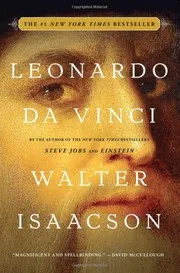
Leonardo Da Vinci
by Walter Isaacson
10 out of 10
Read it! An excellent and inspiring look into Leonardo Da Vinci's curiosity, inner self, and pursuit of making exceptional stuff.
7 highlights
"His notebooks have many other maxims praising the countryside and solitude. “Leave your family and friends and go over the mountains and valleys into the country,” he instructed aspiring painters. “While you are alone you are entirely your own master.”
These paeans to country living are romantic and, for those who cherish the image of lonely genius, quite appealing. But they are infused with fantasy. Leonardo would spend almost all of his career in Florence, Milan, and Rome, crowded centers of creativity and commerce, usually surrounded by students, companions, and patrons. He rarely retreated alone to the countryside for an extended period of solitude. Like many artists, he was stimulated by being with people of diverse interests and (willing to contradict himself in his notebooks) declared, “Drawing in company is much better than alone.” The impulses of his grandfather life, were imprinted in Leonardo’s imagination but not practiced in his life."
"He turned out to be good in geometry, but he never mastered the use of equations or the rudimentary algebra that existed at the time. Nor did he learn Latin. In his thirties he would still be trying to remedy this deficiency by drawing up lists of Latin words, painstakingly writing out awkward translations, and wrestling with grammar rules.
A left-hander, Leonardo wrote from right to left on a page, the opposite direction of the words on this and other normal pages, and drew each letter facing backward. “They are not to be read save with a mirror,” as Vasari described these pages. Some have speculated that he adopted this script as a code to keep his writings secret, but that is not true; it can be read, with or without a mirror. He wrote that way because when using his left hand he could glide leftward across the page without smudging the ink. The practice was not completely uncommon. When his friend the mathematician Luca Pacioli described Leonardo’s mirror writing, he made the point that some other left-handers wrote likewise."
"He sought to portray not only moti corporali, the motions of the body, but also how they related to what he called “atti e moti mentali,” the attitudes and motions of the mind. 41 More important, he was a master at connecting the two. This is most noticeable in his action-packed and gesture-filled narrative works, such as the Adoration and The Last Supper. But it is also the genius behind his most serene portraits, most notably the Mona Lisa.
[...] Leonardo was deeply influenced by Alberti’s book, and he repeatedly echoed that injunction in his own notebooks. “The good painter has to paint two principal things, man and the intention of his mind,” he wrote. “The first is easy and the second is difficult, because the latter has to be represented through gestures and movements of the limbs.”"
"His letter to Ludovico is thus best regarded not as a reliable catalogue of his actual engineering accomplishments but instead as a glimpse into his hopes and ambitions. Nevertheless, his boasts were not completely hollow. Had they been, he would have been easily exposed in a city where weapon design was a deadly serious endeavor. After settling into Milan, he would in fact begin to pursue military engineering earnestly and come up with some innovative concepts for machines, even as he continued to dance around the line between ingenuity and fantasy."
"In order to make his drawing an informative work of science, Leonardo could have used a simplified figure of a man. Instead, he used delicate lines and careful shading to create a body of remarkable and unnecessary beauty. With its intense but intimate stare and the curls of hair that Leonardo flight. There is nothing static except the calm torso, with subtle cross-hatch shadings behind it. Yet despite the sense of motion, there is a natural and comfortable feel to the man. The only slightly awkward positioning is of his left foot, which is twisted outward to provide a measurement guide."
"As I hope you will by now agree, Leonardo was a genius, one of the few people in history who indisputably deserved—or, to be more precise, earned —that appellation. Yet it is also true that he was a mere mortal. The most obvious evidence that he was human rather than superhuman is the trail of projects he left unfinished. Among them were a horse model that archers reduced to rubble, an Adoration scene and battle mural that were abandoned, flying machines that never flew, tanks that never rolled, a river that was never diverted, and pages of brilliant treatises was ever done,” he repeatedly scribbled in notebook after notebook. “Tell me. Tell me. Tell me if ever I did a thing. . . . Tell me if anything was ever made.”
Of course, the things he did finish were enough to prove his genius. The Mona Lisa alone does that, as do all of his art masterpieces as well as his anatomical drawings. But by the end of writing this book, I even began to appreciate the genius inherent in his designs left unexecuted and masterpieces left unfinished. By skirting the edge of fantasy with his flying machines and water projects and military devices, he envisioned what innovators would invent centuries later. And by refusing to churn out works that he had not perfected, he sealed his reputation as a genius rather than a master craftsman. He enjoyed the challenge of conception more than the chore of completion."
"The fact that Leonardo was not only a genius but also very human—quirky and obsessive and playful self-taught and willed his way to his genius. So even though we may never be able to match his talents, we can learn from him and try to be more like him. His life offers a wealth of lessons.
Be curious, relentlessly curious. [...]
Seek knowledge for its own sake. [...]
Retain a childlike sense of wonder. [...]
Observe. [...]
Start with the details. [...]
See things unseen. [...]
Go down rabbit holes. [...]
Get distracted. [...]
Respect facts. [...]
Procrastinate. [...]
Let the perfect be the enemy of the good. [...]
Think visually. [...]
Avoid silos. [...]
Let your reach exceed your grasp. [...]
Indulge fantasy. [...]
Create for yourself, not just for patrons. [...]
Collaborate. [...]
Make lists. [...]
Take notes, on paper. [...]
Be open to mistery. [...]"