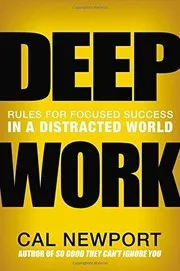
Deep Work
by Cal Newport
10 out of 10
Ultra-relevant for those who want to develop intellectual depth and be more productive.
7 highlights
"The Deep Work Hypothesis: The ability to perform deep work is becoming increasingly rare at exactly the same time it is becoming increasingly valuable in our economy. As a consequence, the few who cultivate this skill, and then make it the core of their working life, will thrive."
"This brings us to the question of what deliberate practice actually requires. Its core components are usually identified as follows: (1) your attention is focused tightly on a specific skill you’re trying to improve or an idea you’re trying to master; (2) you receive feedback so you can correct your approach to keep your attention exactly where it’s most productive."
"If you’re comfortable going deep, you’ll be comfortable mastering the increasingly complex systems and skills needed to thrive in our economy. If you instead remain one of the many for whom depth is uncomfortable and distraction ubiquitous, you shouldn’t expect these systems and skills to come easily to you."
"Deep work is at a severe disadvantage in a technopoly because it builds on values like quality, craftsmanship, and mastery that are decidedly old-fashioned and nontechnological. Even worse, to support deep work often requires the rejection of much of what is new and high-tech. Deep work is exiled in favor of more distracting high-tech behaviors..."
"Many assume that they can switch between a state of distraction and one of concentration as needed, but as I just argued, this assumption is optimistic: Once you’re wired for distraction, you crave it."
"First , distraction remains a destroyer of depth. Therefore, the hub-and-spoke model provides a crucial template. Separate your pursuit of serendipitous encounters from your efforts to think deeply and build on these inspirations. You should try to optimize each effort separately, as opposed to mixing them together into a sludge that impedes both goals. Second , even when you retreat to a spoke to think deeply, when it’s reasonable to leverage the whiteboard effect, do so. By working side by side with someone on a problem, you can push each other toward deeper levels of depth, and therefore toward the generation of more and more valuable output as compared to working alone."
"The deep life, of course, is not for everybody. It requires hard work and drastic changes to your habits. For many, there’s a comfort in the artificial busyness of rapid e-mail messaging and social media posturing, while the deep life demands that you leave much of that behind. There’s also an uneasiness that surrounds any effort to produce the best things you’re capable of producing, as this forces you to confront the possibility that your best is not (yet) that good. It’s safer to comment on our culture than to step into the Rooseveltian ring and attempt to wrestle it into something better. But if you’re willing to sidestep these comforts and fears, and instead struggle to deploy your mind to its fullest capacity to create things that matter, then you’ll discover, as others have before you, that depth generates a life rich with productivity and meaning."