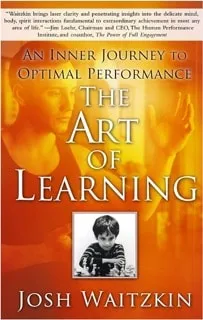
The Art of Learning
by Josh Waitzkin
10 out of 10
An enlightening, inspiring, and beautiful journey about learning, one of the most relevant skills to cultivate.
3 highlights
"In the long run, painful losses may prove much more valuable than wins—those who are armed with a healthy attitude and are able to draw wisdom from every experience, “good” or “bad,” are the ones who make it down the road. They are also the ones who are happier along the way. Of course the real challenge is to stay in range of this long-term perspective when you are under fire and hurting in the middle of the war. This, maybe our biggest hurdle, is at the core of the art of learning."
"My search for the essential principles lying at the hearts of and connecting chess, the martial arts, and in a broader sense the learning process, was inspired to a certain extent by Robert Pirsig’sZen and the Art of Motorcycle Maintenance . I’ll never forget a scene that would guide my approach to learning for years to come. The protagonist of Pirsig’s story, a brilliant if eccentric man named Phaedrus, is teaching a rhetoric student who is all jammed up when given the assignment to write a five-hundredword story about her town. She can’t write a word. The town seems so small, so incidental—what could possibly be interesting enough to write about? Phaedrus liberates the girl from her writer’s block by changing the assignment. He asks her to write about the front of the opera house outside her classroom on a small street in a small neighborhood of that same dull town. She should begin with the upper-left hand brick. At first the student is incredulous, but then a torrent of creativity unleashes and she can’t stop writing. The next day she comes to class with twenty inspired pages. I believe this little anecdote has the potential to distinguish success from failure in the pursuit of excellence. The theme is depth over breadth. The learning principle is to plunge into the detailed mystery of the micro in order to understand what makes the macro tick."
"Grandmasters know how to make the subtlest cracks decisive. The only thing to do was become immune to the pain, embrace it, until I could work through hours of mind-numbing complexities as if I were taking a lovely walk in the park. The vise, after all, was only in my head. I spent years working on this issue, learning how tomaintain the tension—becoming at peace with mounting pressure. Then, as a martial artist, I turned this training to my advantage, making my opponents explode from mental combustion because of my higher threshold for discomfort. In every discipline, the ability to be clearheaded, present, cool under fire is much of what separates the best from the mediocret. In competition, the dynamic is often painfully transparent. If one player is serenely present while the other is being ripped apart by internal issues, the outcome is already clear."