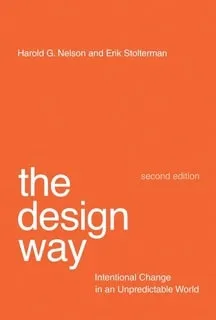
The Design Way
by Harold Nelson, Erik Stolterman
9 out of 10
A systemic and deep look at the design practice. I recommend it to anyone with some experience who wants to go deeper.
5 highlights
"The wisdom of the knowing hand - that of making, producing, and acting - must be connected to the wisdom of reason. But, wisdom in the realm of design requires that we take a step back. Design wisdom requires the reconstitution of sophia. Design wisdom is an integration of reason with observation, reflection, imagination, action, and production or making.
Ano ther demand that design wisdom makes on us is to reintroduce the analog into a world long dominated by the digital and the analytic."
"There is no scientific approach for creating an ultimate particular because science is a process of discrning abstranctions that apply accross categories or taxonomies of phenomena, while the ultimate particular is a singular and unique composition or assembly. Creating that wihch is unique and thus particular, therefore, cannot be acomplished using a scientific approach.
An action taken by an individual at a specific time and place is an example of something that is an ultimate particular. The outcome of a specific design process, such as a chair, a curriculum, or a policy, is an ultimate particular. It is something unique. It is not the universal chair, the universal curriculum, or the universal policy. We create a particular, which when taken together with other particulars, makes p the whole of our experienced reality."
"Conscious knowing: reason
Unconscious knowing: intuition
Subconscious knowing: imagination
Conscious not-knowing: design thinking."
"Judgment is not a form of decision making as commonly understood. It is not dependent on rules of logic found within rational systems of inquiry. Judgment is not founded on strict rules of reasning. It is more likely to be dependent on the accumulation of the experience of consequences from choices made in complex situations. However, judgment is not irrational, because it follows its own form of intuitive logic. Learning to make judgments is not a matter of learning to follow steps of a technique, or to follow directions dictated by a method or algorithm, or to impose the a priori constraints of a theory. Wittgenstein stated: "What one acquires here is not a technique; one learns correct judgments. There are also rules, but they do not form a system, and only experienced people can apply them right. Unlike calculating-rules" (Wittgenstein 1963).
Judgment is, by definition, an elusive animal. It is the expression of the work of the subconscious mind, and as distinct from rational decision making as it is from intuition."
"Good designers do not accept any situation as given; instead they always begin by asking challenging questions to better understand the true nature of what they are dealing with. They never settle for the "problem" as presented to them by clients, users, or stakeholders. They do not accept the initial ideas for "solutions" given to them, not even by people who live and work in the situation and who see themselves as experts in the environment. Designers always need to expose the underlying forces of change that their design intervention is expected to successfully confront, modify, and use. They try to become aware of problematic symptoms, and they try to expose underlying forces and root causes that need to be taken into account when attempting to actualize expressions of desiderata for the particular situation at hand."