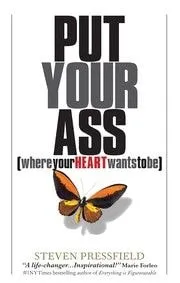
Put Your Ass Where Your Heart Wants To Be
by Steven Pressfield
6 out of 10
This book is not highly useful, but I recommend it for people in their twenties as it offers practical tips to increase their chances of success.
4 highlights
"Leave the town or city where you live and move to the hub of the creative or entrepreneurial world where your dreams are most likely to come true.”
"My own office today is just a converted bedroom. It’s got nothing esoteric in it, except maybe my lucky toy cannon that fires inspiration into me or perhaps my lucky horseshoe from Keeneland in Lexington, Kentucky.But it’s a sacred space too.I’ve made it sacred by the work I’ve done there and by the attitude of respect and devotion I bring with me when I enter. Kids can come in. Animals can hang out. But they have to be respectful too, as I and my brother were when we crossed the doorstep of Peter the painter’s studio.”
"You and I, as writers and artists, are playing always for tomorrow. Our game is the long game.
When you’re tired, stop.”
"An opportunity may be presented to us that we would have jumped at in a prior incarnation—say, to acquire wealth or to achieve great personal or professional recognition—and we may turn it down. An enterprise or adventure may capture our imagination—one that entails grave hazard or expense, that may cause distress and anguish to those we love—and we may choose to embrace it anyway.
A revolutionary upheaval may occur in the life of our community or nation and we may say to ourselves, “I must take a stand, even if it means risking everything.” Or in the same instance we may conclude, “This convulsion is ego-spawned madness. My proper function is to keep myself and my family safe until it subsides. I will not participate in this state of affairs, nor abet its furtherance in any way.”
When we put our ass where our heart wants to be, we may change where we live; we may alter what we do to support ourselves. We may rethink the way we dress or wear our hair. We may shave our skull; we may acquire tattoos—or efface them. We may change political parties, invent new ones, or drop out entirely. Our taste in music, books, art, or movies may change. We may discard longstanding habits and addictions. We may acquire new enthusiasms, make new friends. We may marry or divorce.
We may change the time we get up in the morning and the hour we go to bed at night. We may rethink the people we choose to associate with. We may make over the way we eat or sleep or decide or act. That which we had previously considered important, even vital or indispensable, we may now shed as lightly as a worn-out coat. We may elect to simplify our life. We many choose to live ten times larger. We may change our religion or drop religion entirely.
Those who had admired us, or supported our ambitions in the past, may now turn against us. The violence of their hostility may surprise or even overwhelm us. The people closest to us, our own parents or children, may become estranged from us, or us from them.
Simultaneously we may find ourselves drawn to others whom we had previously overlooked or even despised. We may find ourselves living in another country, speaking another language.
The measures by which we judged a person’s or an activity’s or aspiration’s value or utility may be overthrown. They may become the exact opposite of what they had been. We may come to dread death as we never had before—or lose all fear of it. We may relocate to the center of things or evacuate to the periphery.
Our priorities change when we make the shift from the ego to the Self. Our field of consciousness broadens. We see ourselves no longer as an isolated element in a random or meaningless universe. Instead, our passage through this material dimension acquires significance, even if we can’t articulate what that significance is. We sense ourselves as part of a greater cosmos, extending without limit into the past and projecting infinitely into the future.
We become conscious of our own gift. We no longer doubt this or dismiss it or despise it. Instead, we resolve to serve it. We may still fear personal extinction. We may still worry about our children’s futures and the health of our community and nation and planet. But we come at these concerns from a different place and with a different sense of what kind of difference we can make and how and why, or even if we wish to attempt to make a difference at all.
We have become artists, not in the precious sense of differentiating ourselves from others in some imagined superior way, but in the sense of being servants of an intention that comes from somewhere else, even though we cannot grasp what that intention is or what its source may be. We trust this intention somehow, even though we can’t say why.”