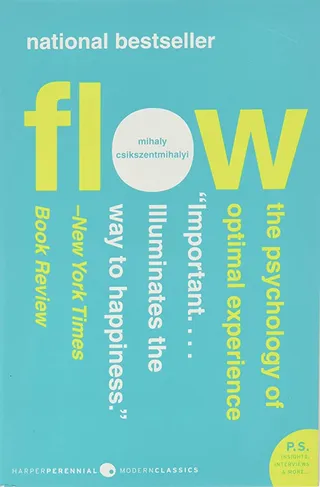
Flow
by Mihaly Csikszentmihalyi
10 out of 10
One of the most important books I have ever read. It will help you reflect on much of what you do [or don't do] and give you valuable directions for building a better self.
7 highlights
"This paradox of rising expectations suggets that improving the quality of life might be an insurmountable task. In fact, there is no inherent problem in our desire to escalate our goals, as long as we enjoy the struggle along the way. The problem arises when people are so fixated on what on what they want to achieve that they cease to derive pleasure from the present. When that happens, they forfeit their chance of contentment."
"Some people learn to use this priceless resource [attention] efficiently, while others waste it. The mark of a person who is in control of consciousness is the ability to focus attention at will, to be oblivious to distractions, to concentrate for as long as it takes to achieve a goal, and not longer."
"The self becomes complex as a result of experiencing flow. Paradoxically, it is when we act freely, for the sake of the action itself rather than for ulterior motives, that we learn to become more than what we were. When we choose a goal and invest ourselves in it to the limits of our concentration, whatever we do will be enjoyable. And once we have tasted this joy, we will redouble our efforts to taste it again. This is the way the self grows."
"So loss of self-consciousness does not involve a loss of self, and certainly not a loss of consciousness, but rather, only a loss of consciousness of the self. What slips below the threshold of awareness is the concept of self, the information we use to represent to ourselves who we are. And being able to forget temporarily who we are seems to be very enjoyable. When not preoccupied with our selves, we actually have a chance to expand the concept of who we are. Loss of self-consciousness can lead to self-transcendence, to a feeling that the boundaries of our being have been pushed forward."
"We don’t usually notice how little control we have over the mind, because habits channel psychic energy so well that thoughts seem to follow each other by themselves without a hitch. After sleeping we regain consciousness in the morning when the alarm rings, and then walk to the bathroom and brush our teeth. The social roles culture prescribes then take care of shaping our minds for us, and we generally place ourselves on automatic pilot till the end of the day, when it is time again to lose consciousness in sleep. But when we are left alone, with no demands on attention, the basic disorder of the mind reveals itself. With nothing to do, it begins to follow random patterns, usually stopping to consider something painful or disturbing. Unless a person knows how to give order to his or her thoughts, attention will be attracted to whatever is most problematic at the moment: it will focus on some real or imaginary pain, on recent grudges or long-term frustrations. Entropy is the normal state of consciousness—a condition that is neither useful nor enjoyable. To avoid this condition, people are naturally eager to fill their minds with whatever information is readily available, as long as it distracts attention from turning inward and dwelling on negative feelings."
"In philosophy as in other disciplines there comes a point where a person is ready to pass from the status of passive consumer to that of active producer. To write down one’s insights expecting that someday they will be read with awe by posterity would be in most cases an act of hubris, that “overweening presumption” that has caused so much mischief in human affairs. But if one records ideas in response to an inner challenge to express clearly the major questions by which one feels confronted, and tries to sketch out answers that will help make sense of one’s experiences, then the amateur philosopher will have learned to derive enjoyment from one of the most difficult and rewarding tasks of life."
"The “autotelic self” is one that easily translates potential threats into enjoyable challenges, and therefore maintains its inner harmony. A person who is never bored, seldom anxious, involved with what goes on, and in flow most of the time may be said to have an autotelic self. The term literally means “a self that has self-contained goals,” and it reflects the idea that such an individual has relatively few goals that do not originate from within the self. For most people, goals are shaped directly by biological needs and social conventions, and therefore their origin is outside the self. For an autotelic person, the primary goals emerge from experience evaluated in consciousness, and therefore from the self proper."